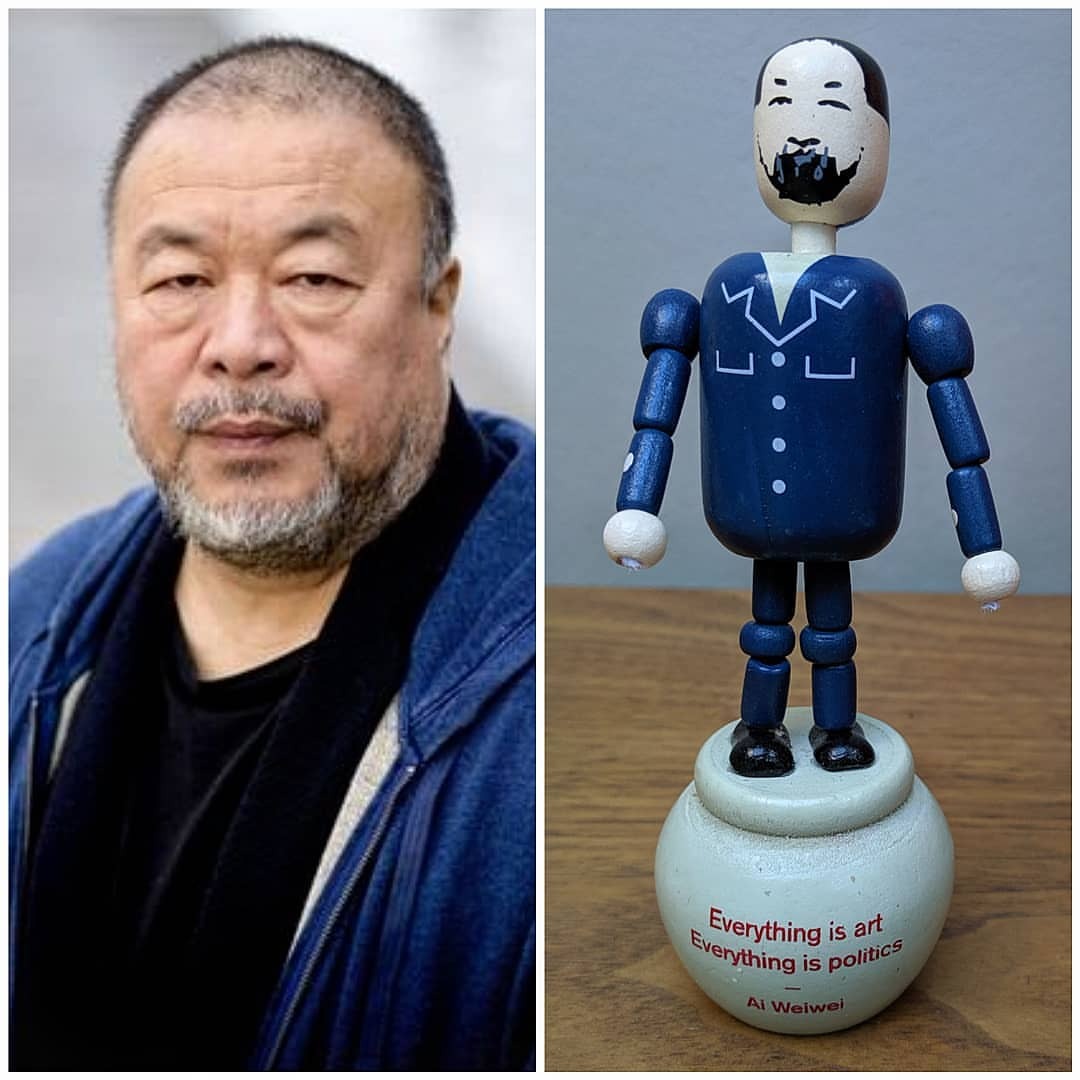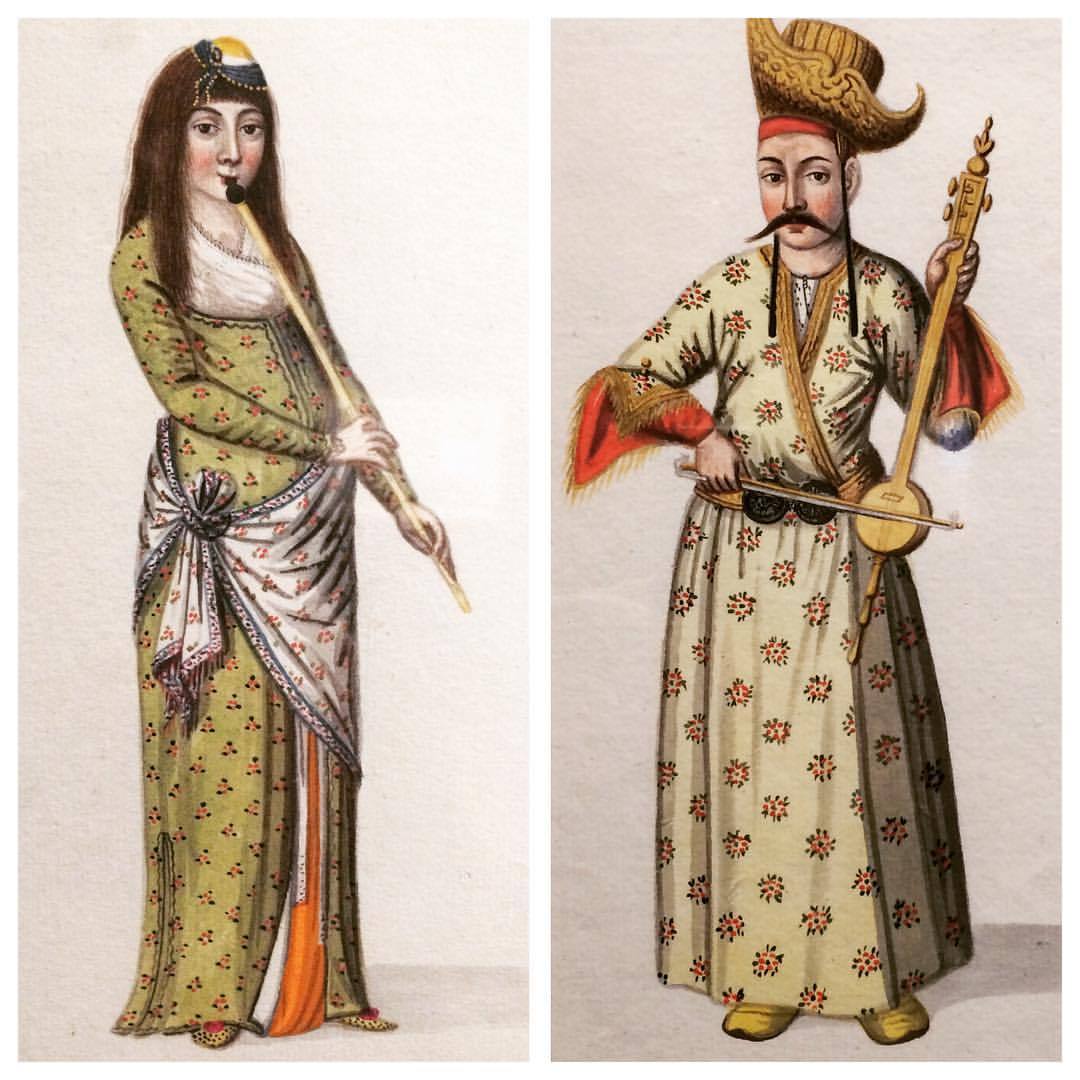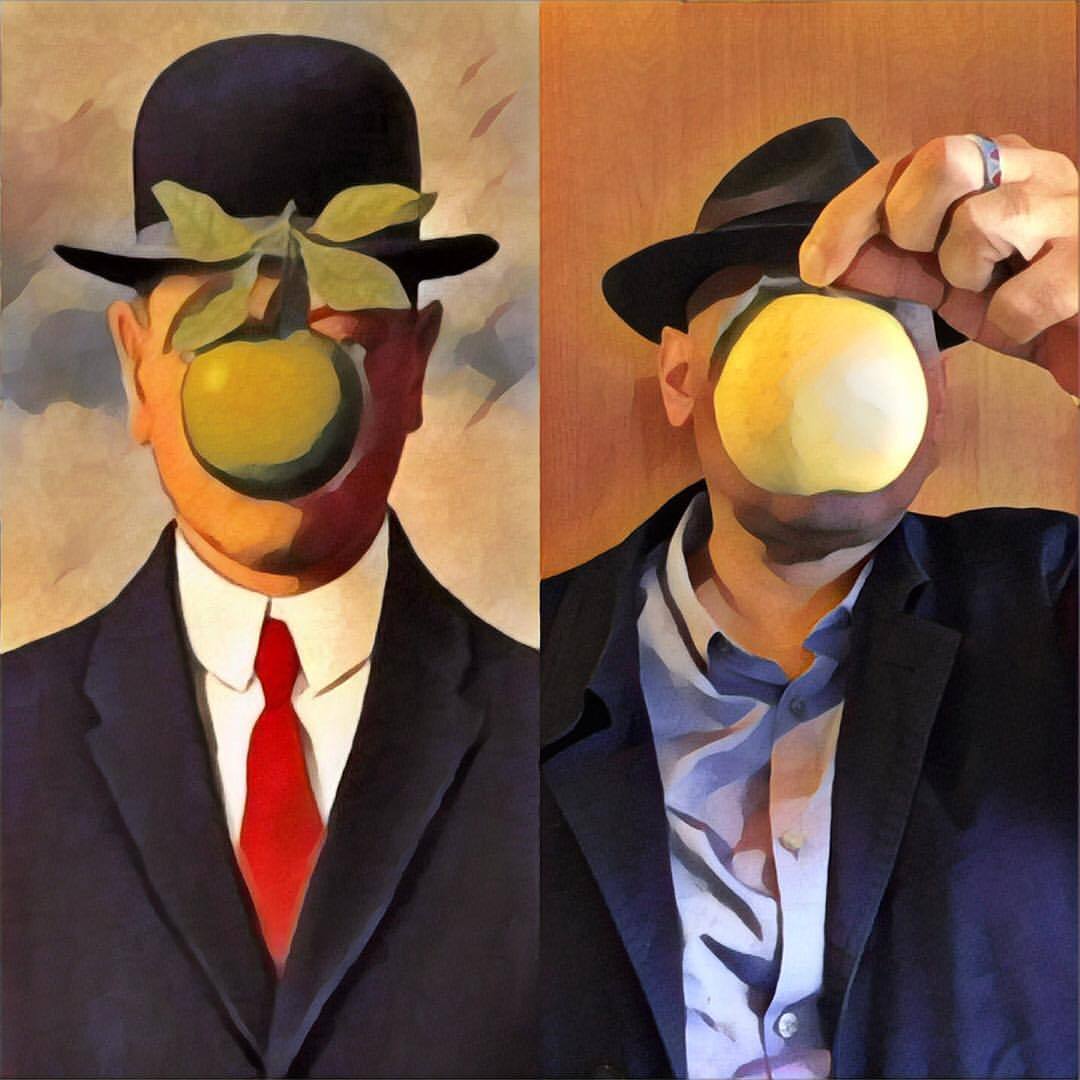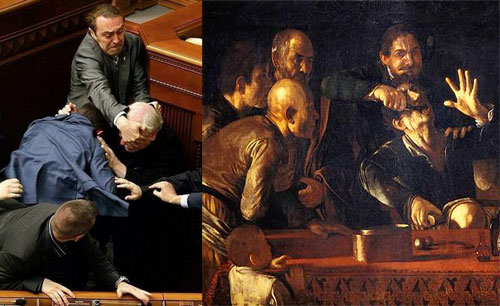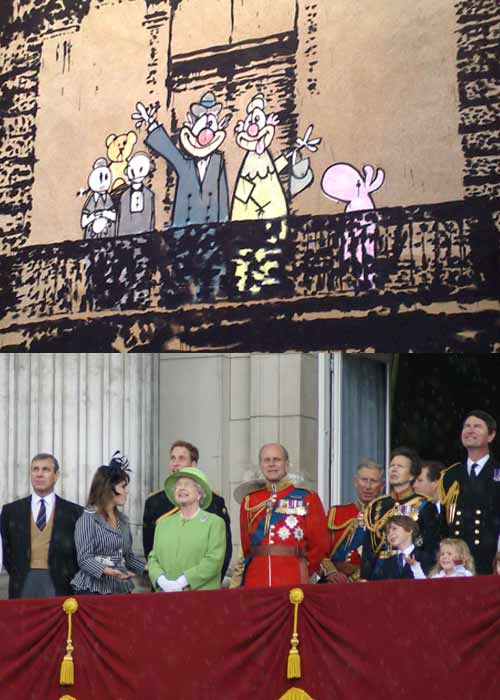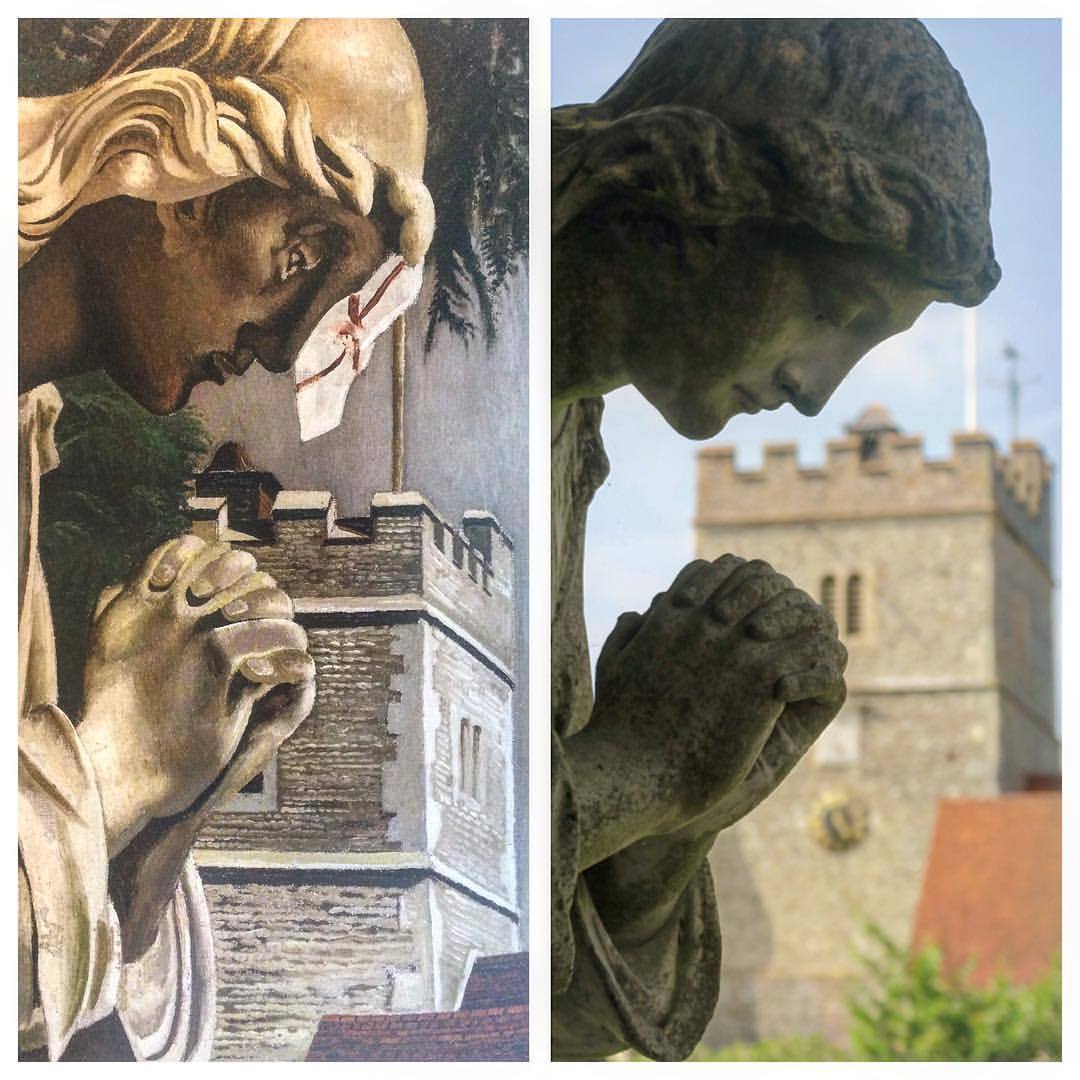
“The Angel, Cookham Churchyard 1936” a painting by Stanley Spencer and a picture l have taken today.
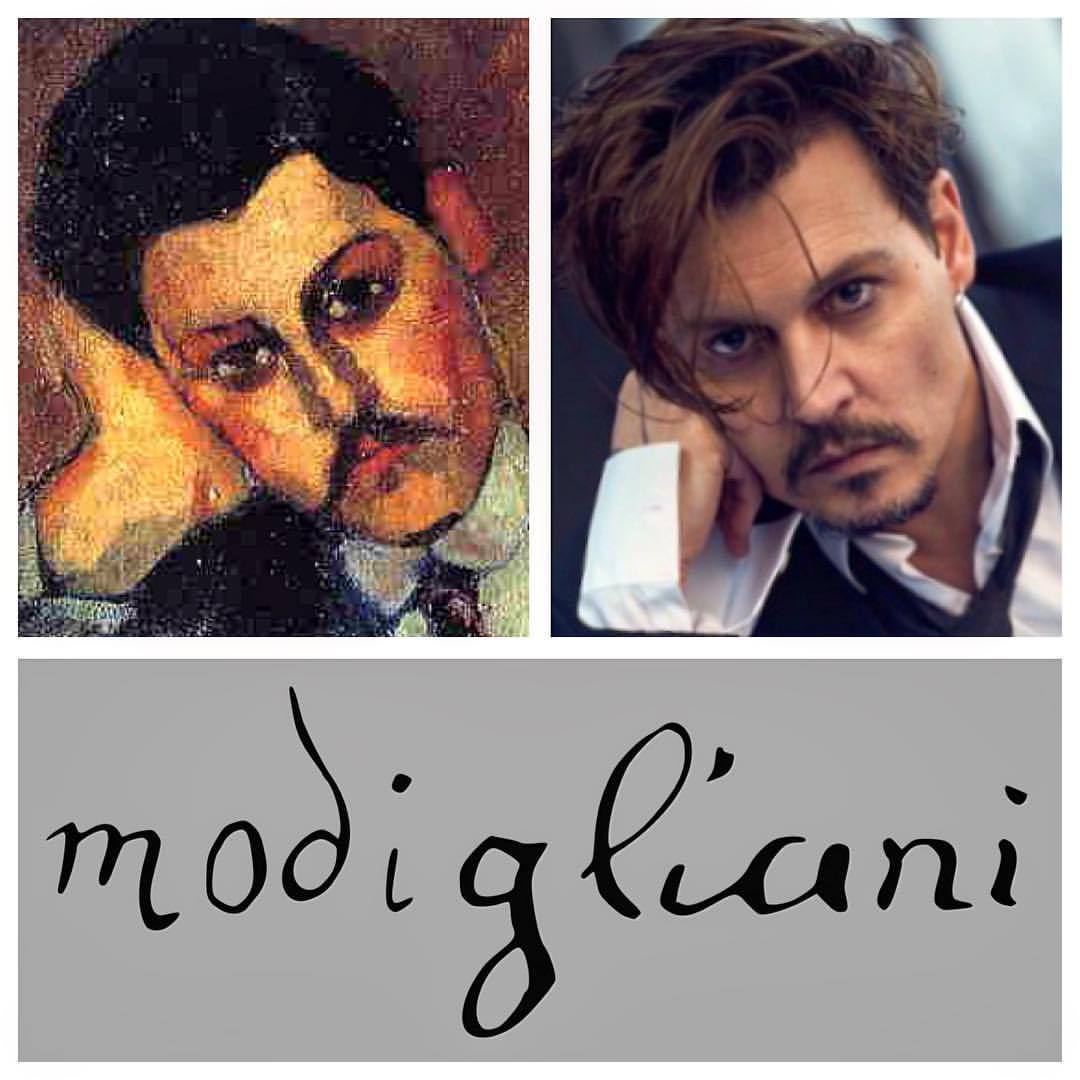
Yesterday I spotted Johnny Depp in Modigliani exhibition at Tate Modern.
The picture on the left is Dr Paul Alexandre who was Modigliani's first patron.
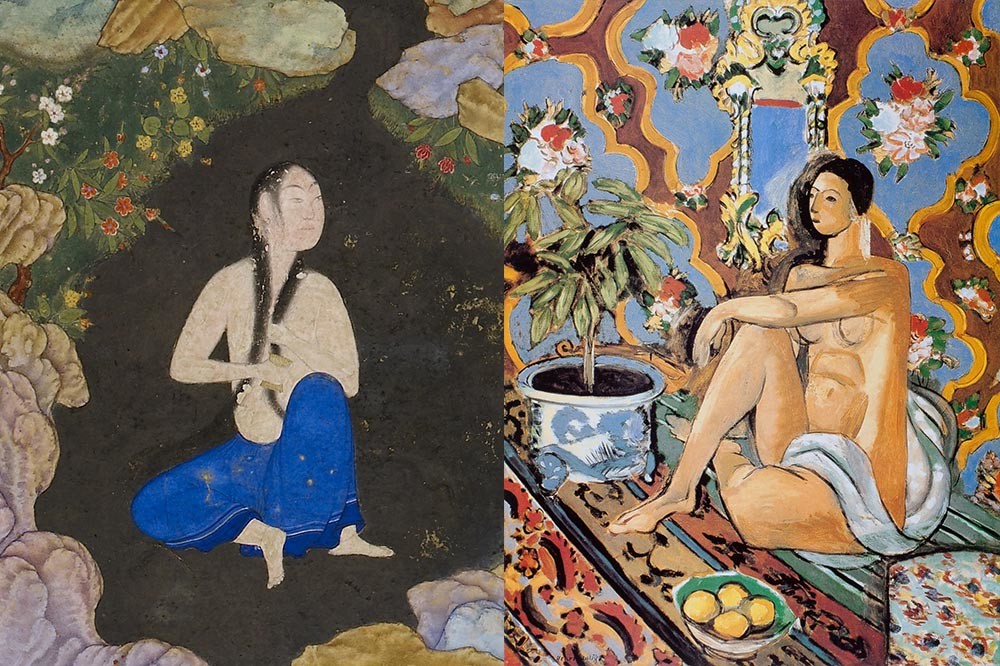
According to Professor Michael Barry, Matisse was overwhelmed by the Persian miniatures in the Paris and Munich exhibitions of 1903, 1910 and 1912, then by masterpieces in southern Spain and Morocco during his three journeys there between 1911 and 1913.
Professor Barry's illustrated talk will explore these connections in depth, within the context of painting’s amazing aesthetic revolution in the early 20th century.
Matisse and Islamic Art
16 October 2017, 19:00-20:30
Hallam Conference Centre, 44 Hallam Street, London W1W6JJ
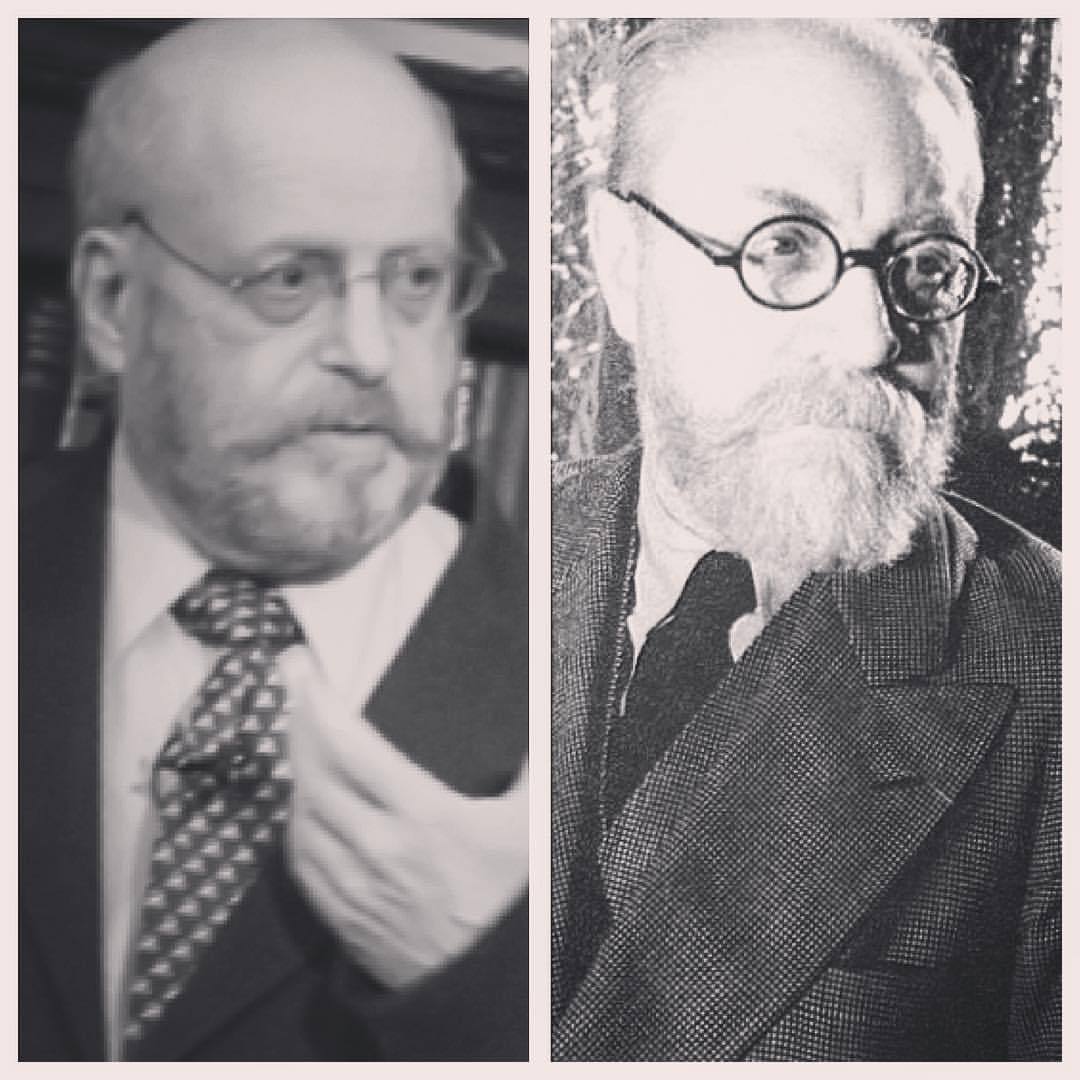
* I went to Professor Michael Barry’s brilliant lecture on Matisse & Islamic Art.
As if Matisse was there himself giving the lecture!
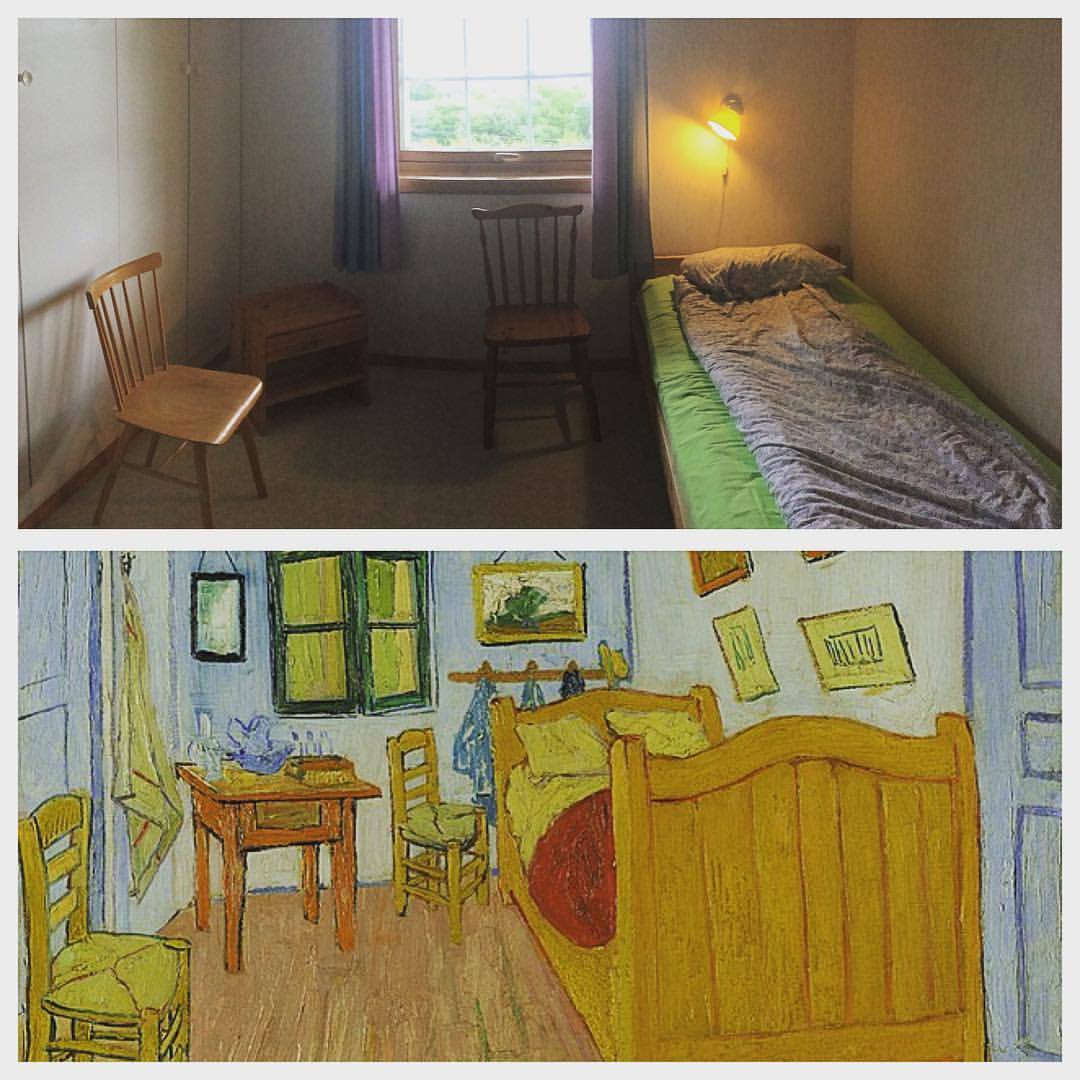
Bedrooms in Hafslo (Norway) & Arles (France)
Bedroom in Arles is the title given to each of three similar paintings by Vincent van Gogh. Van Gogh's own title for this composition was simply The Bedroom.
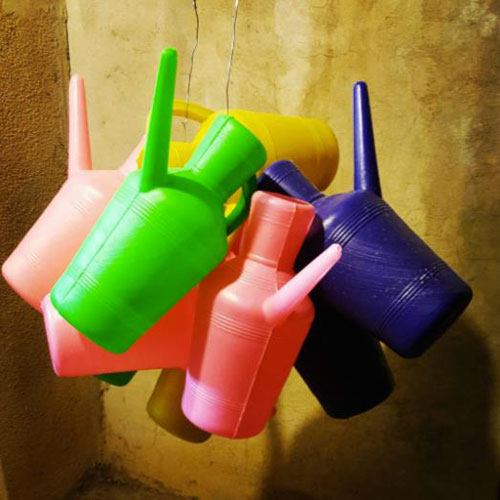
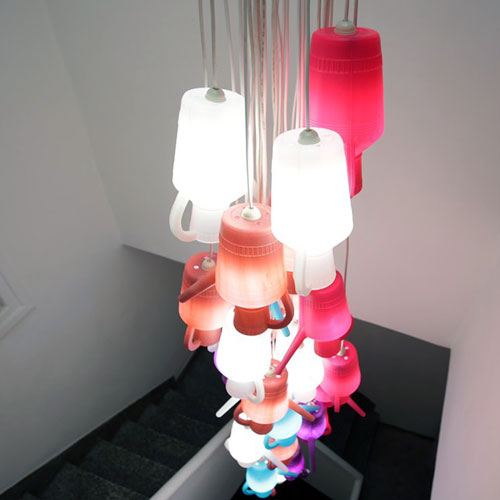
A photo of plastic ewers (aftabeh) taken by my cousin in Shiraz and "Tehran Candella" by Scottish artist David Batchelor, a site-specific work at AB-ANBAR Gallery in Tehran.
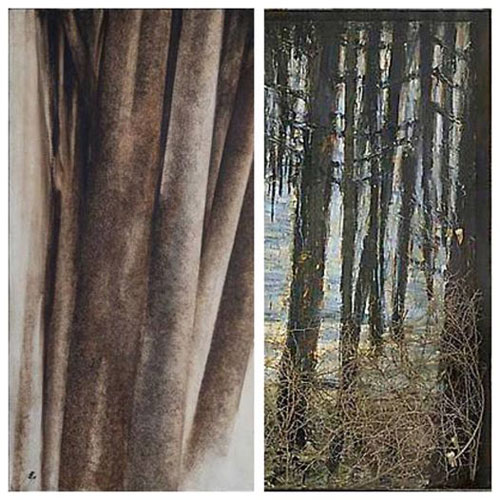
Trees by Sohrab Sepehri & Anselm Kiefer
"Tonight I must go!
I must take a suitcase
Big enough to contain my shirt of loneliness
And walk in a direction
Where epic-singing trees can be seen" ~ Sohrab Sepehri
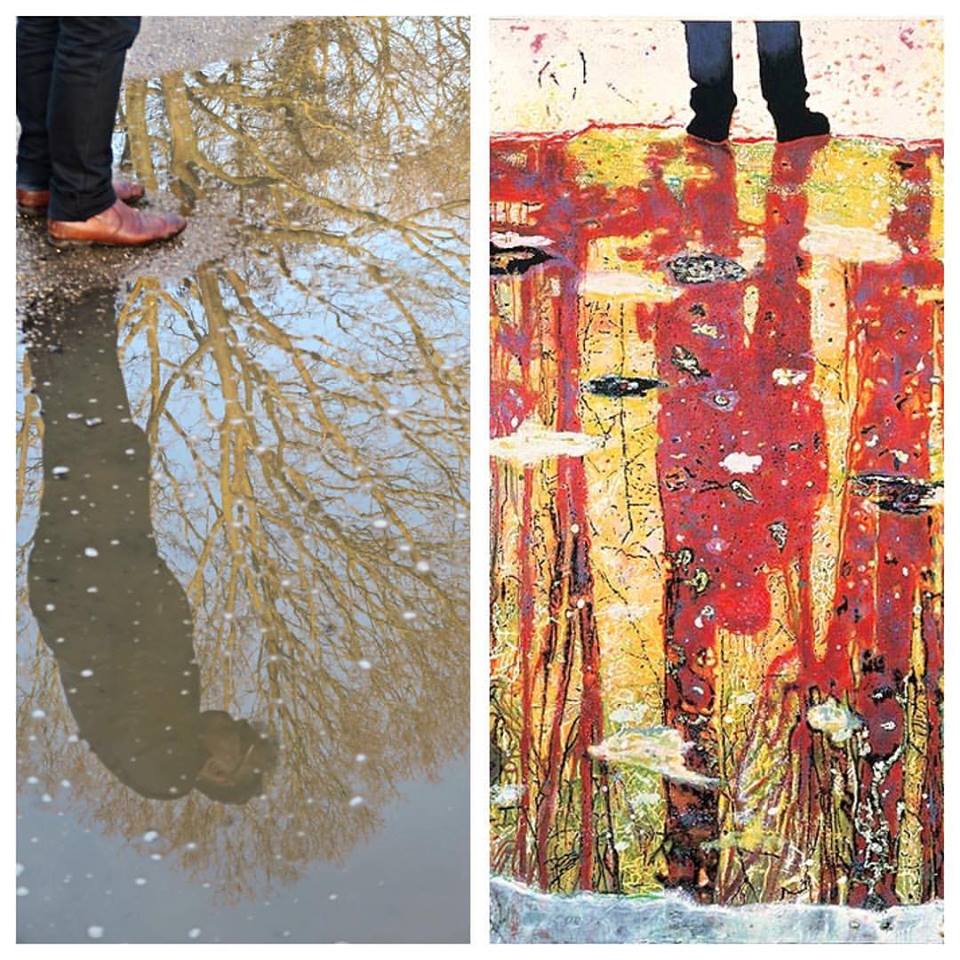
A good friend & Reflection (What Does your Soul Look Like?) by the painter Peter Doig.
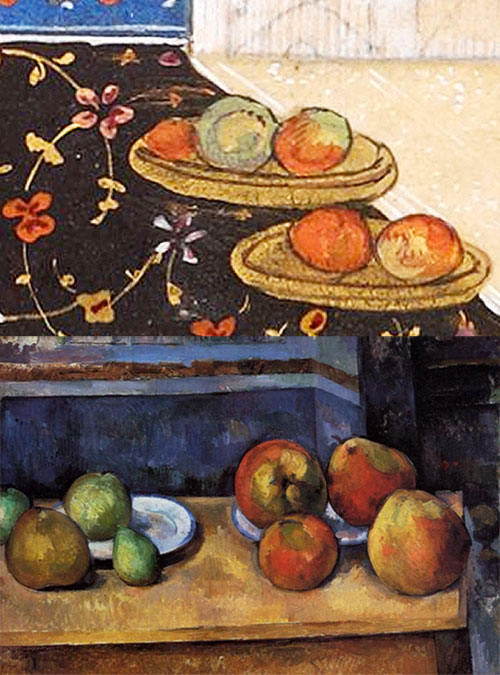
Detail from a miniature in Bustan of Sadi 1629 and Paul Cezanne's Still Life Apples and Pears 1887
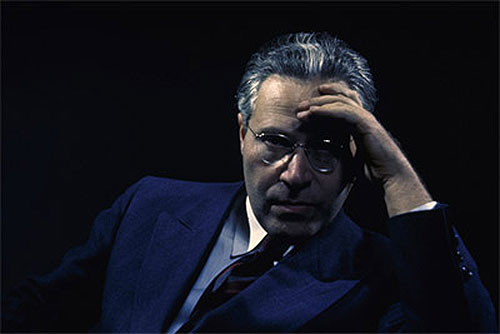
László Moholy-Nagy self-portrait (1944), part of his early experimentation with colour transparencies. He was born on this day in 1895.
Moholy-Nagy was a Hungarian painter and photographer as well as a professor in the Bauhaus school.
He was highly influenced by constructivism and a strong advocate of the integration of technology and industry into the arts.
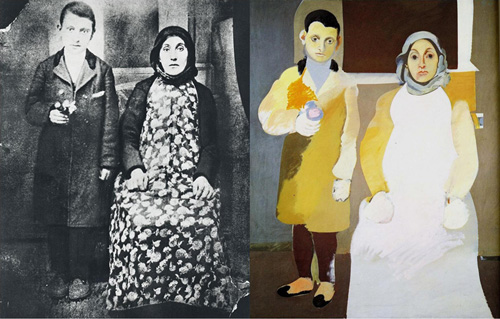
Arshile Gorky's The Artist and His Mother (ca. 1926–1936), Whitney Museum of American Art, New York City.
Arshile Gorky (Vosdanig Manoug Adoian, 1904-48), one of the greatest American painters, was born in the village of Khorgom, on the shores of Lake Van in eastern Turkey. He was a survivor of the Armenian Genocide.
Metamorphose: 1999 documentary on the life and work of Dutch graphic artist M.C. Escher (1898-1972)
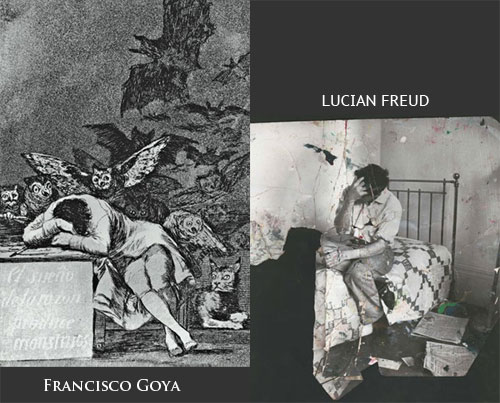
The Sleep of Reason Produces Monsters is an etching by the Spanish painter and printmaker Francisco Goya. Goya imagines himself asleep amidst his drawing tools, his reason dulled by slumber and bedevilled by creatures that prowl in the dark.
The image on the right is an old photograph of the artist Lucian Freud. In the picture, Freud sits on a bed, holding his right hand to his forehead in a gesture of weariness or despair.
MoMA New York is currently hosting a new exhibition entitled Jasper Johns: Regrets, which displays works by the American artist inspired by this photograph.
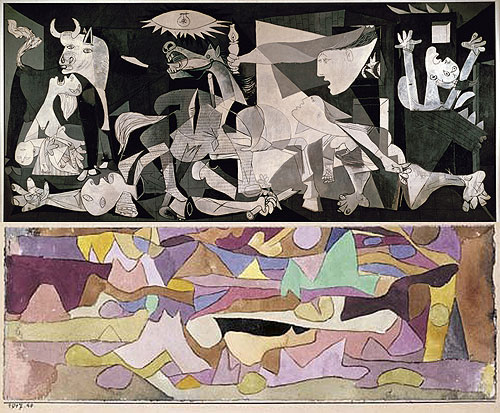
Picasso's Guernica - Oil on canvas, 349 cm × 776 cm, 1937
& Klee's Untitled - Watercolour and pen on paper, 9.5 cm x 28 cm, 1917
Paul Klee — Making Visible is at Tate Modern until March 9, 2014
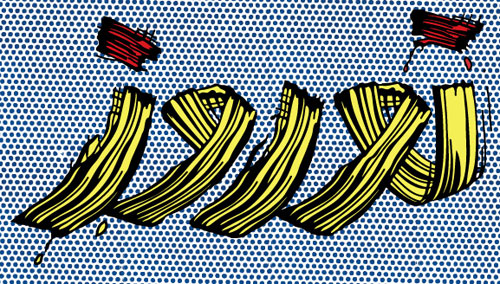
Nowruz in Persian in the style of Roy Lichtenstein
By Mehrdad Aref-Adib 2013
Lichtenstein: A Retrospective
Tate Modern: Exhibition
21 February ? 27 May 2013
Conversations with History host Harry Kreisler talked to Nobel laureate Orhan Pamuk in 2009. Pamuk reflected on his intellectual journey, including the influence of his parents, writers who shaped his world view, the "huzun" of Istanbul, writing, and recurring themes in his novels.
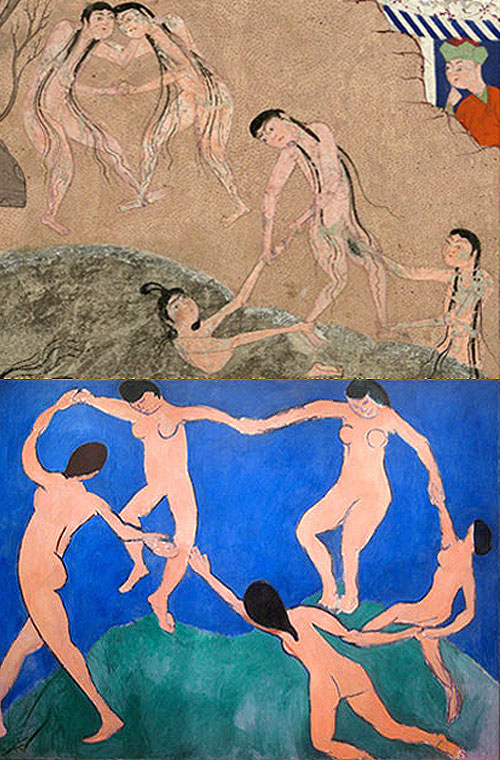
Detail from a Safavid illuminated manuscript, Five Poems (quintet), Alexander the Great watches naked girls swim in the Sea of China, 1518
& The Dance (La Danse) by Henri Matisse, 1909
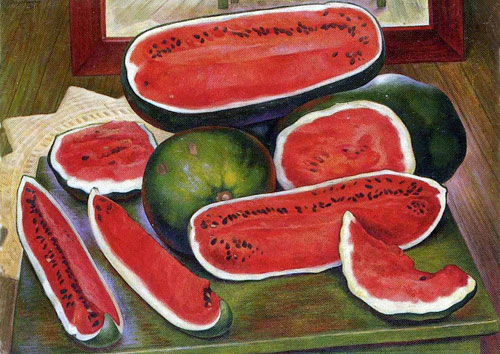
Diego Rivera - The Watermelons - 1957
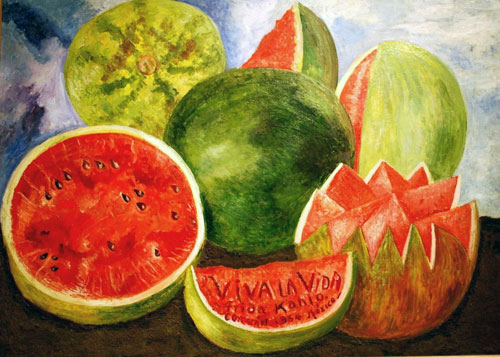
Frida Kahlo - Viva la Vida, Watermelons - 1954
Apparently, both Frida Kahlo's and Diego Rivera's last paintings are of watermelons.
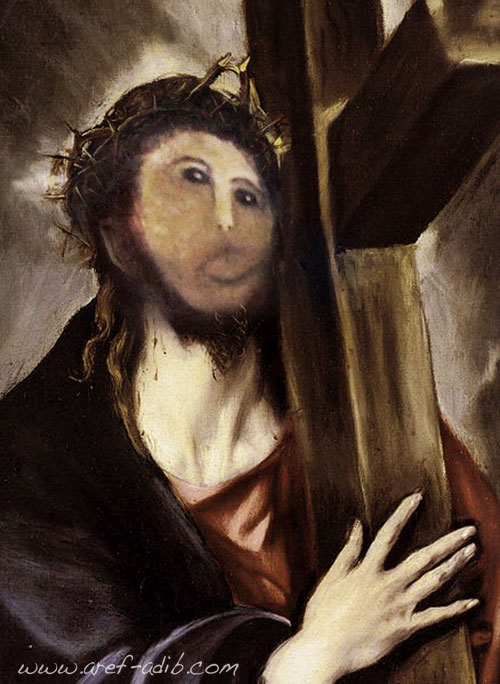
Jesus- after El Greco
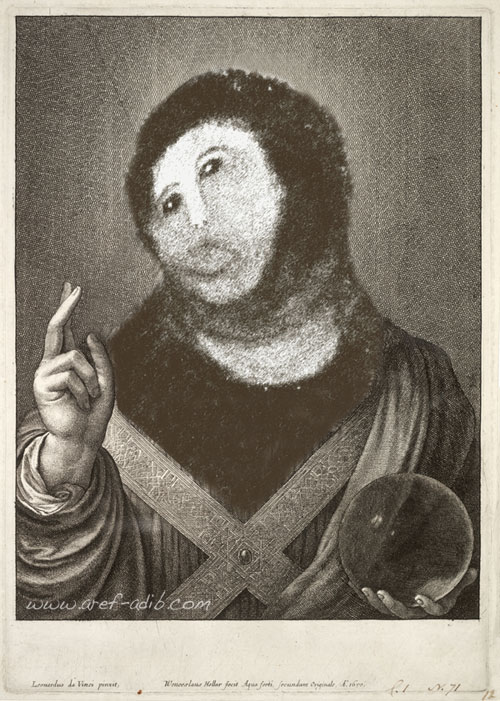
Jesus after Leonardo
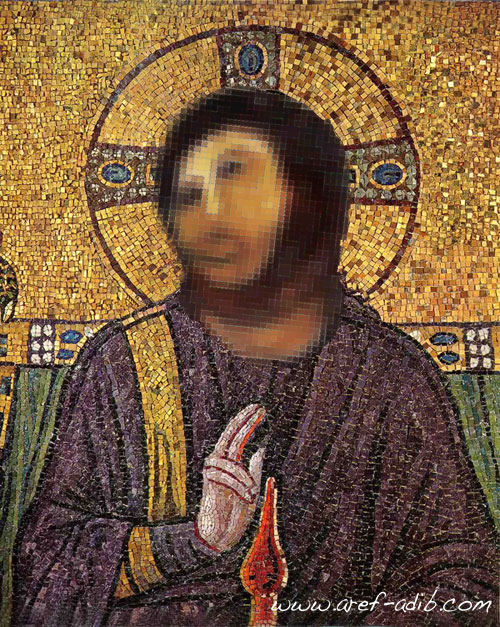
Jesus, Mosaic
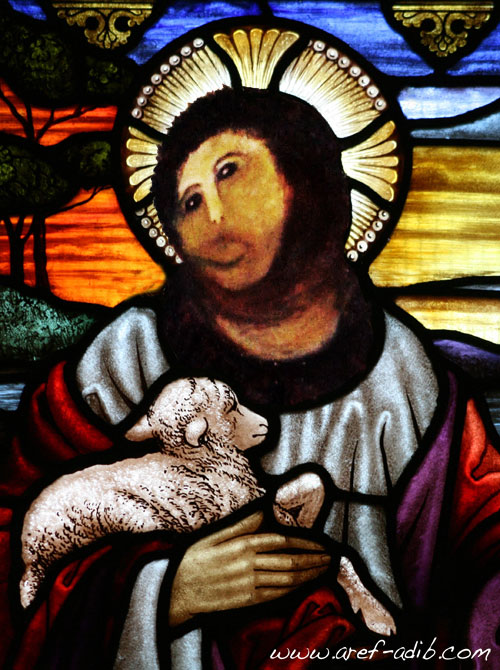
Jesus, Stained Glass
An elderly woman had restored a 19th-century fresco Ecce Homo in Borja (Zaragoza, Spain).
The fresco was ruined after a good Samaritan attempted a DIY restoration of the artwork.
The amateur restorer had undertaken the project with good intentions but, as culture councillor Juan Maria de Ojeda said, "she had gotten out of hand".
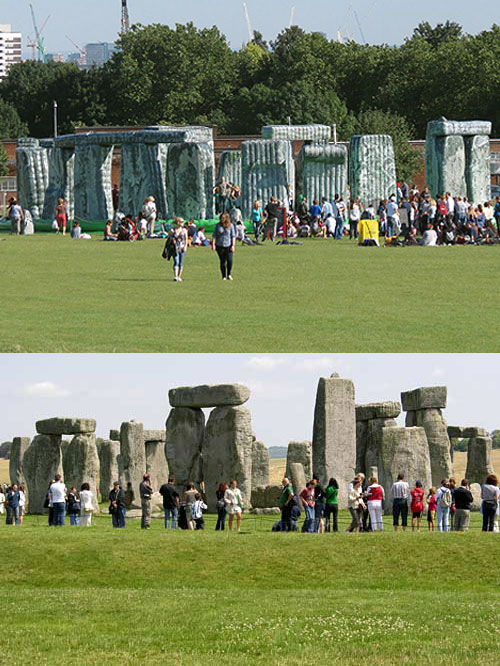
Bouncy & not so bouncy Stonehenges
Sacrilege is a life-sized inflatable replica of Stonehenge for people to bounce on by Turner Prize-winning artist Jeremy Deller.
Parliament Hill, Hampstead Heath, London
August 1, 2012
Jackson Pollock, Guardians of the Secret, 1943
San Francisco Museum of Modern Art
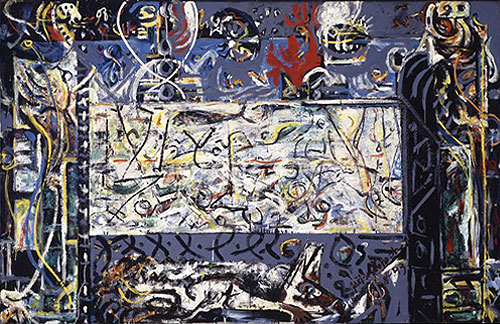
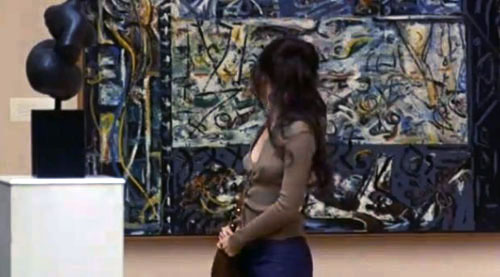
Girl in Museum on Jackson Pollock's Guardians of the Secret :
It restates the negativeness of the universe, the hideous lonely emptiness of existence, nothingness, the predicament of man forced to live in a barren, godless eternity, like a tiny flame flickering in an immense void, with nothing but waste, horror, and degradation, forming a useless bleak straightjacket in a black absurd cosmos.
"Play It Again, Sam", 1972
Starry Night (interactive animation) from Petros Vrellis on Vimeo.
Van Gogh's Starry Night interactive animation

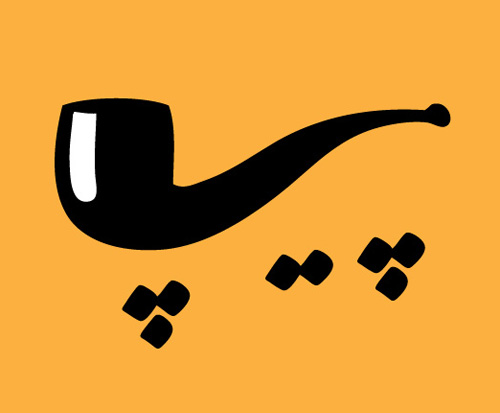
My Iranian version of Ren? Magritte's most famous painting:
The Treachery of Images (La trahison des images), 1928?29
Painting by Chinese artists Dai Dudu, Li Tiezi, & Zhang An, 2006, oil on canvas
The painting depicts 105 political & cultural iconic personalities.
How many of them can you recognise?
Tiles depicting the story of Yusuf and Zulaikha
Iran, 2nd half of the 19th century, Qajar Period (1779 - 1925)
The Ashmolean Museum, Oxford
These tiles come from two different sets depicting the story of Yusuf and Zulaikha. Based on the Sura Yusuf, the 12th sura of the Qur'an, it originally derives from the story of Joseph and Potiphar?s wife in the Old Testament.
In the Qur?anic version, Yusuf is a handsome slave in the service of an Egyptian man. His master?s wife, named Zulaikha in later literature, attempts to seduce him unsuccessfully.
These tiles depict the episode of Yusuf?s appearance before the women of Memphis. Overcome by his beauty, they faint or cut themselves with the knives they hold in their hands!
Rustic Figures & Animals, Shanghai province, 1985
By Cheng Shifa (1921 ? 2007), The Ashmolean Museum of Art & Archaeology, Oxford
Cheng Shifa (1921 ?2007) was a Chinese calligrapher, painter and cartoonist. He was born in a small Chinese village outside the city of Shanghai in 1921. He studied traditional Chinese painting at Shanghai Art Academy in the late 1930s, and subsequently earned a living through illustration. After visiting southwest China in the late 1950s he specialised in paintings of China?s national minorities. In 1956 he joined the Shanghai Chinese Painting Academy, of which he later became a director. During the 1970s his attention turned to bird and flower painting.
Ai Weiwei's animal zodiac sculpture installation at Somerset House, London
Iranian artist Shirin Neshat talks about the paradox of being an artist in exile. In her work, she explores Iran pre- and post-Islamic Revolution, tracing political and societal change through powerful images of women.
Neshat?s provocative photographs and video installations have resonated with the curators of many major international art exhibitions, including the Venice Biennale, where she won the top prize in 1999. Her first feature film, Women Without Men, tells the stories of four women struggling to escape oppression in Tehran. It won her the Silver Lion for best director at the 2010 Venice Film Festival.
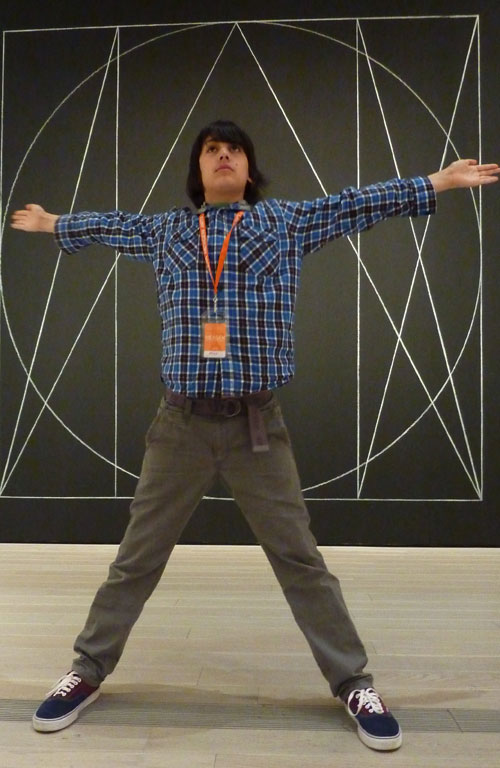
The Vitruvian Max (after the world-renowned drawing by Leonardo da Vinci - The Vitruvian Man)
The Wall Drawing behind Max is by Sol LeWitt and is in Los Angeles County Museum of Art.
Sol LeWitt's wall drawings are radical because they are temporary and are meant to be executed by others based on the artist's directions. The LeWitt's instructions for this work are: "Six white geometric figures (outlines) superimposed on a black wall." The museum's staff use this sentence as a guide when they re-create it for different exhibitions!
Single Form: The Body in Sculpture from Rodin to Hepworth
This small display at Tate Britain is based on the single human figure. Apparently it is a conscious reflection of the first display to be held in Duveen Gallery at Tate in 1937. At that time the galleries included works by French sculptors, such as Auguste Rodin and Aristides Maillol ? whose influence was especially important in Britain.
Tate Britain, until 4 September 2011
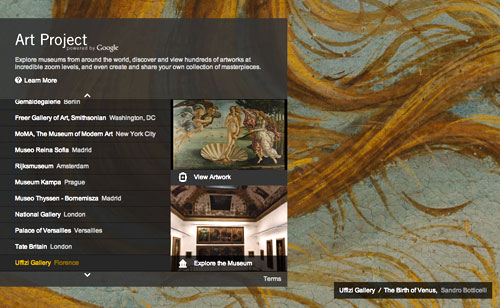
Today Google has announced its new Art Project, which is the result of a unique 18-month collaboration with the world's most acclaimed art galleries and museums. It looks very impressive.
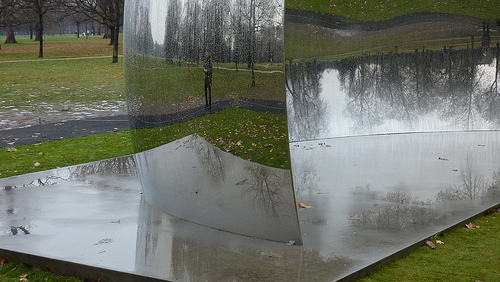
Anish Kapoor, C-Curve 2007, Stainless steel
Anish Kapoor's giant curved mirror sculptures now have an outdoor setting. Four sculptures, creating distortions of their surroundings, have taken up residence among the trees and waters of Kensington Gardens.
Ai Weiwei's Sunflower Seeds at Tate Modern & some real seeds!
This enormous installation at Tate Modern is the work of Chinese artist Ai Weiwei. Around 150 tons of sunflower seeds have been used but these seeds are made of porcelain and each one has been individually molded and hand-painted.
A Captive Audience? Cast glass, wood and metal, David Reekie, V&A Glass Galleries
In A Captive Audience? the current issue of cloning has provided Reekie with a look-alike band of unquestioning drones. But one at the back, has noticed something over the fence and may yet make a dash for freedom.
Tate Liverpool from Mehrdad Aref-Adib on Vimeo.
Best known for his huge animated constructions of junk, Jean Tinguely also made small sculptures. Here hand tools are brought together in an electrically-driven three dimensional collage.
Mus?e National d'Art Moderne, Centre Georges Pompidou, Paris, 17 April 2010.
Jarvis Cocker was at St Pancras International to launch Eurostar Culture Connect, encouraging cross channel passengers to visit cultural institutions in London, Paris, and Brussels. Now when you travel with Eurostar, you can show your inbound tickets at the selected galleries and museums and get 2 for 1 entry to all paying exhibitions or permanent collections.
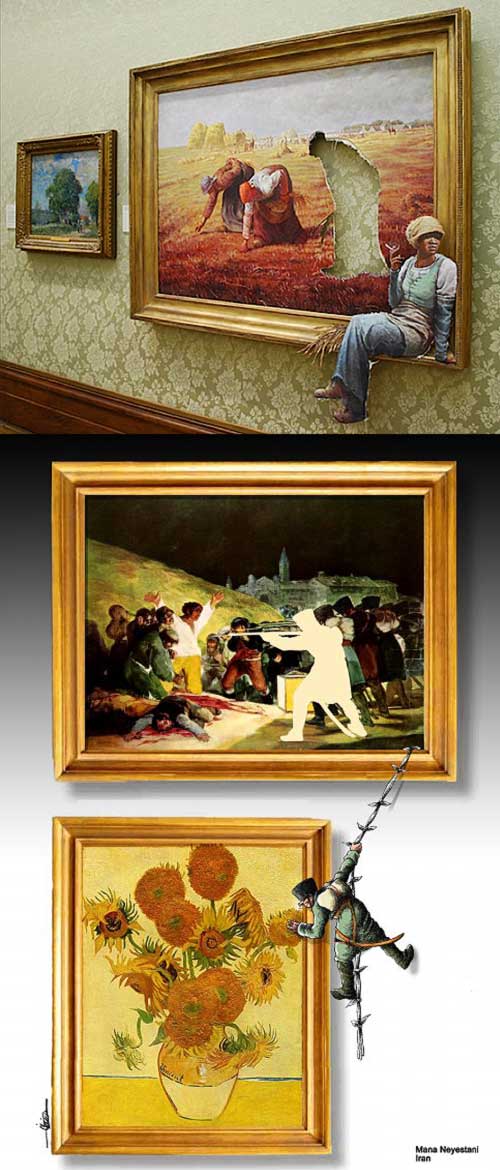
Banksy's version of Jean-Fran?ois Millet's The Gleaners.
Banksy also has a great version of Van Gogh's Sunflowers called Crude Oils: Sunflowers From Petrol Station.
The other is Mana Neyestani's version of Francisco Goya's The Third of May 1808.
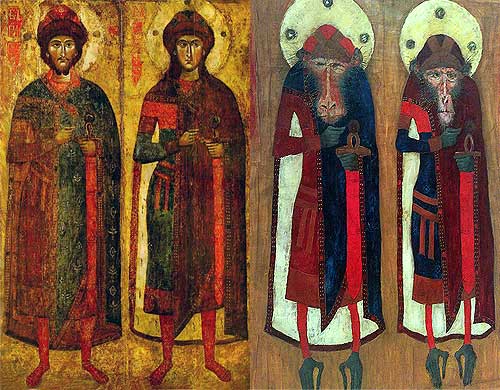
Medieval Russian icon of Saints Boris and Gleb (14th century) and a new version I saw at The Saatchi Gallery.
The Empire Strikes Back: Indian Art Today, The Saatchi Gallery, London, until May 7 2010
Revolution on Paper: Mexican Prints 1910-1960
Mexican Revolution prints at the British Museum
22 October 2009 - 5 April 2010
The exhibition is the first in Europe to focus on the great age of Mexican printmaking in the first half of the 20th century. It features 130 works by over 40 artists including prints by Diego Rivera, Jos? Clemente Orozco and David Alfaro Siqueiros.
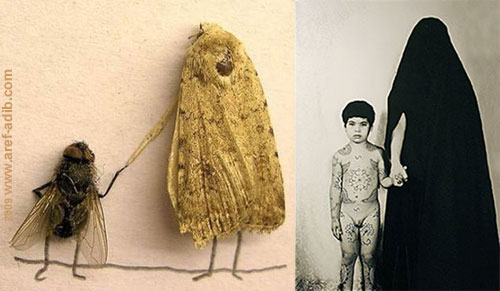
The Dead Fly Art is by Magnus Muhr and the photo on the right is by artist Shirin Neshat.
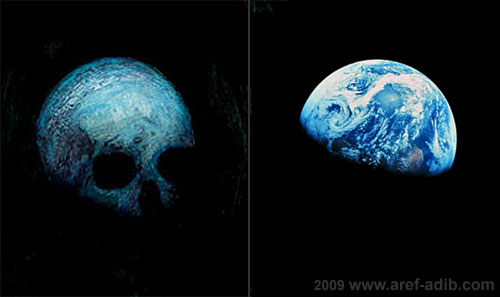
Floating Skull by Damien Hirst (2006) and photo of Earthrise over the lunar horizon taken during the Apollo 8 moon mission (1968)
The exhibition No Love Lost: Blue Paintings by Damien Hirst is at The Wallace Collection from Oct. 14, 2009, to Jan. 24, 2010. It features 25 works done between 2006 and 2008 that mark the artist?s return to painting.
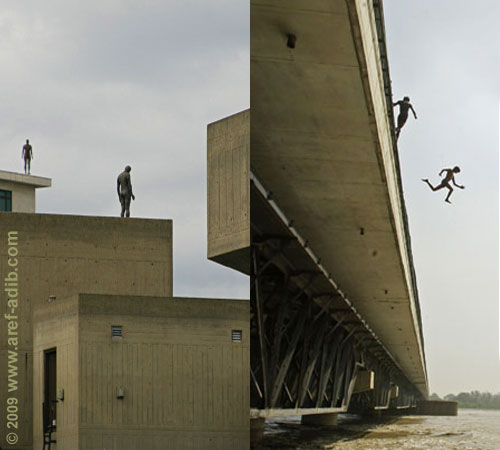
Antony Gormley statues on the roof of the South Bank Centre, London and boys jumping into a river from a bridge in Delhi, India.
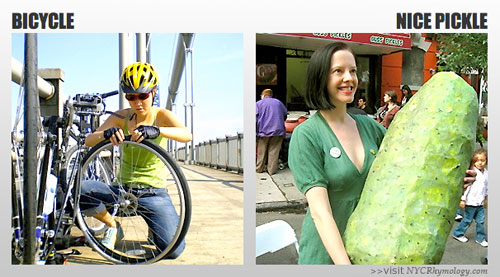
I really like the NYC Rhymology website which offers a colourful glimpses of New York City. David Donnell, the man behind the site, illustrates rhymes by putting two contrasting photos next to each other. The rhymology approach can provide infinite possibilities related to any subject or setting.
Last week I went to Bita Ghezelayagh?s first solo exhibition in London. It featured a collection of felt capes. She treats her felt capes as canvasses on which she expresses her memories of growing up in Iran. She was brought up in Tehran where she lived through the Iranian revolution of 1979 and Iran-Iraq war (1980-88). She is heavily influenced by post-revolutionary visual popular culture.
A thousand and one metal keys, crowns, tulips and images of a renowned Iran-Iraq war hero printed onto metal tags are sewn onto the garments. She combines these with Iranian slogans ? such as "Martyrdom is the Key to Paradise".
Bita Ghezelayagh says: "making my first designs, and travelling around Iran searching for the best techniques, I came across a display of felt shepherds? capes in a provincial bazaar. They hung inertly, heavily, a reminder of earthy tradition amid the gaudy consumer goods, and were a poignant validation of Joseph Beuys? elevation of felt into art."
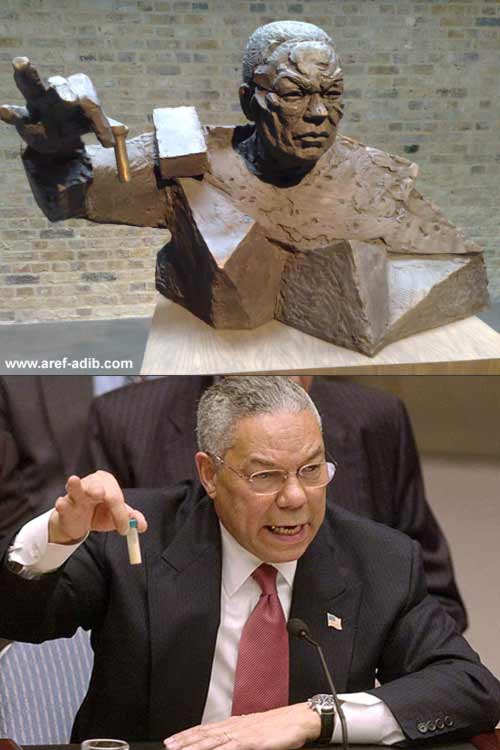
The sculpture of former US Secretary of State Colin Powell is based on a photograph taken when he addressed the UN in 2003, making the case for war, and is part of Goshka Macuga's exhibition at the newly redeveloped Whitechapel Gallery.
There is a new display of an artwork by Iranian artist Khosrow Hassanzadeh at The British Museum to accompany 'Shah Abbas' exhibition. It focuses on Gholamreza Takhti, an Olympic champion and national hero of Iran. Takhti was a Jahan Pahlavan, a ?World Wrestler?, who died tragically young at the age of 37 in 1968. The affection that Iranians feel for him rests not only on his prowess as a sportsman but on his personality, his sense of fair play and his kindness.
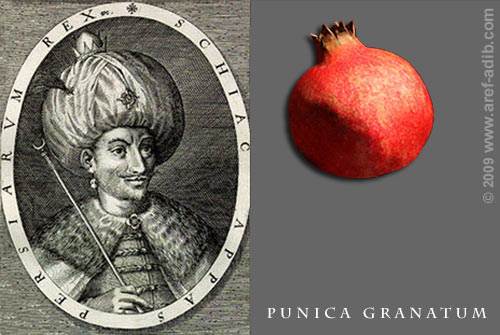
Shah Abbas King of the Persians and Pomegranate
There is a major new exhibition Shah Abbas: The Remaking of Iran at the British Museum, London. The exhibition explores seventeenth-century Iran through the reign and legacy of one of its most influential rulers, Shah Abbas I (reigned AD 1587?1629).
The Old Persons Home by Sun Yuan and Peng Yu
(13 life size sculptures and 13 dynamo electric wheel chairs, The Saatchi Gallery)
Sun Yuan and Peng Yu are two of China's most controversial artists. The Old Persons Home is a satirical models of OAPs looking like old world-leaders, long crippled and impotent, left to battle it out in true geriatric style.
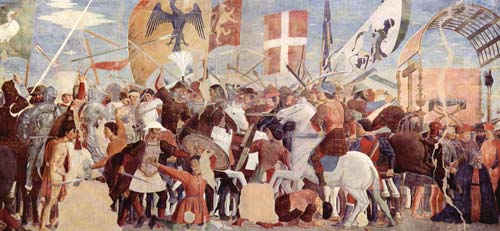
Battle between Heraclius' army and Persians under Khosrau II (Khosrau Parviz)
Fresco by Piero della Francesca, c. 1452
>> Click here to view larger image
Archaeologists have just discovered almost 300 gold coins dating from the 7th Century at a dig just outside Jerusalem's Old City. The solid 24-carat coins were under a large rock in a car park. The coins date back to the reign of the Byzantine Emperor Heraclius, before the Persians conquered Jerusalem. The archaeologists believe that the coins were probably hidden by someone fleeing the Persians.
According to Khodadad Rezakhani of www.vishistorica.com, Khosrau II attacked Jerusalem before Heraclius became king. At the time, Phokas was the Emperor, and he had just killed Maurice, the former emperor and a close ally of Khosrau.
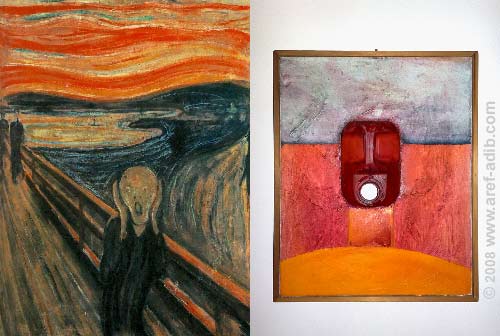
The Scream, the expressionist painting by Norwegian artist Edvard Munch and my work (mixed media from 1989).
>> Click here to see the larger images
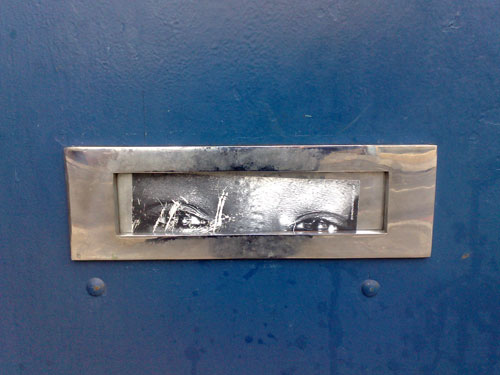
We went Street Art hunting in East London today.
>> Click here to see the results
>> There is an interesting video of Shoreditch graffiti on gofindit.net
>> Vandalog is a great blog on Street Art
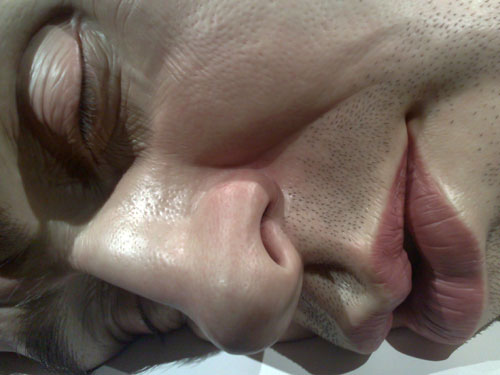
Mask II, mixed media by Ron Mueck
The huge head (Mueck?s self-portrait) is currently on display at the British Museum.
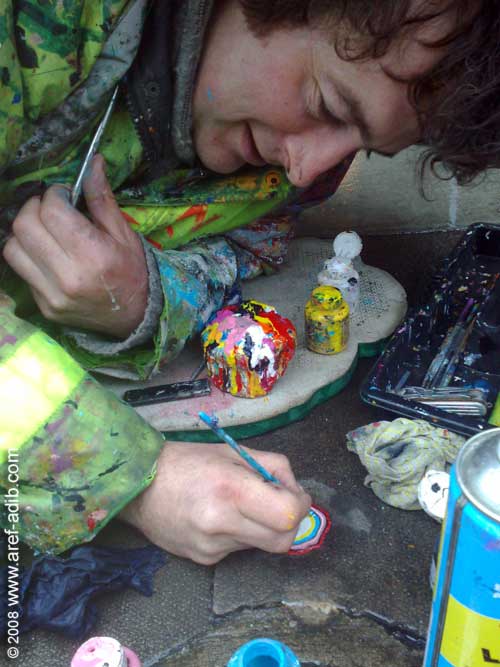
Ben Wilson paints on a chewing gum in Crouch End
Ben Wilson spends everyday on the streets of North London, painting on the blobs of chewing gum that deface London's pavements. Apparently painting on the pavement is illegal so he paints on chewing gum that is stuck to it.
>> This is a collection of images of Ben Wilson's chewing gum art

A commercial exhibition of contemporary Middle Eastern art is to be held from 7th to 25th October in London.
The exhibition 'Routes' will showcase the work of 15 artists originally from Iran and Middle east.
There will be works available by:
Hamra Abbas (Kuwaiti, b.1976)
Maliheh Afnan (Iranian, b. 1935)
Afsoon (Iranian, b.1961)
Fereydoun Ave (Iranian, b. 1945)
Lalla Essaydi (Moroccan, b. 1956)
Nja Mahdaoui (Tunisian, b. 1937)
Farhad Moshiri (Iranian, b. 1963)
Laila Muraywid (Syrian, b. 1956)
Shirin Neshat (Iranian, b 1957)
Naveed Nour (Iranian, b. 1963)
Fereydoon Omidi (Iranian, 1967)
Monir Shahroudy Farmanfarmaian (Iranian, b. 1924)
Laila Shawa (Palestinian, b. 1940)
Parviz Tanavoli (Iranian, b. 1937)
Wijdan (Jordanian, b. 1939)
Charles Zenderoudi (Iranian, b. 1937)
Full biographies of the artists taking part in Routes can be accessed at www.artroutes.com
Waterhouse & Dodd, 26 Cork Street, London W1S 3ND
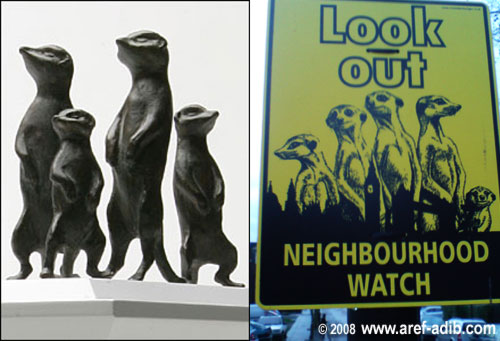
A meerkat family is one of the six shortlisted proposals that could occupy one of London's most popular tourist spots, Trafalgar Square.
The six shortlisted proposals for the next commission for the Fourth Plinth in Trafalgar Square were unveiled at the National Gallery. The exhibiting artists are Jeremy Deller, Tracey Emin, Antony Gormley, Anish Kapoor, Yinka Shonibare and Bob & Roberta Smith. Each artist has produced a maquette of their proposed artwork for the empty plinth. The models are on public display in the National Gallery until 30 March 2008.
>> View the proposed artworks here
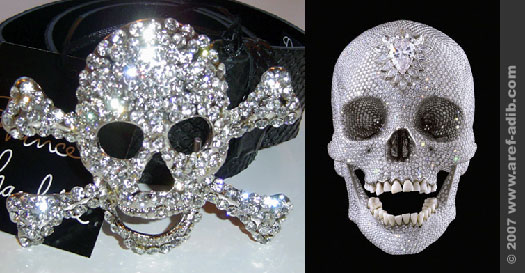
A diamante skull belt & Damien Hirst's diamond-encrusted human skull
Skulls are the hottest thing at the moment. Artist Damien Hirst has unveiled a diamond-encrusted human skull worth ?50m. It said to be the most expensive piece of contemporary art.
The Birds of War exhibition was initiated by Tanya Tier to mark the 4th anniversary of the Iraq invasion. The exhibition is an opportunity to view a collaboration between British and Iraqi artists and their interpretations of the war.
>> The Birds of War website
Hawks, Doves and illegal Eagles
Candid Arts Trust
3 Torrens St, Islington, London Ec1v 1nq
April 11th - 17th, 2007
Mon-Fri 10am - 5pm
Sat-Sun 10am - 4pm
Admission Free
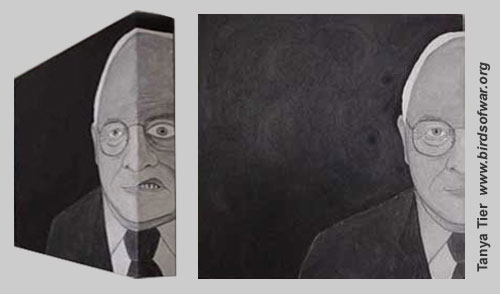
DICK CHENEY 12? x 12? Acrylic and oil on canvas by Tanya Tier
When Dick Cheney talks his lip curls into a snarl on one side and his left eye widens, resulting in half his face looking totally deranged.
A work by Jackson Pollock has just become the most expensive painting sold.
>> Here is my mum's priceless Ashe Reshteh!
>> Here you can make your own Abstract Expressionist work
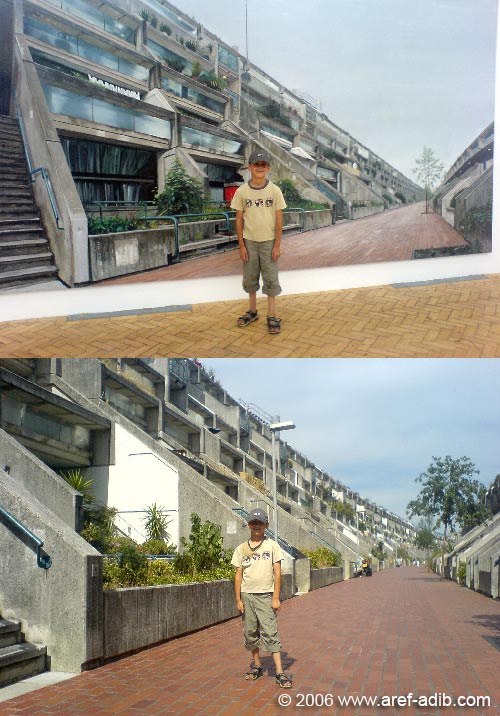
Painting by Yves B?lorgey of Boundary Road, Abbey Road NW8.
(September 2005 Oil on canvas, diptych. Archipeinture exhibition at Camden Art Centre).
And a photo I took today at Boundary Road.
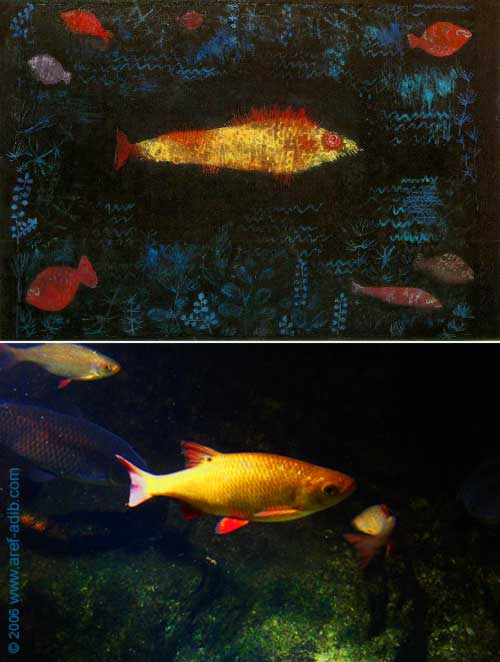
The Goldfish by Paul Klee [Swiss painter, 1879-1940] Oil and watercolor on paper, 49 x 69 cm , 1925 and a photo I took at London Aquarium.
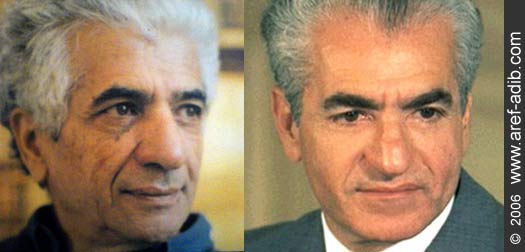
Iranian sculptor Parviz Tanavoli & Mohammad Reza Pahlavi
Word into Art: Artists of the Modern Middle East is a new exhibition at the British Museum. The exhibition demonstrates the imaginative ways in which artists across the Middle East and North Africa are using the power of the written word in their art today. It includes wonderful examples of calligraphy transforming writing into art, books of poetry, and works which reflect current issues facing the modern Middle East. Sculptures in the British museum?s Great Court include works by Parviz Tanavoli.
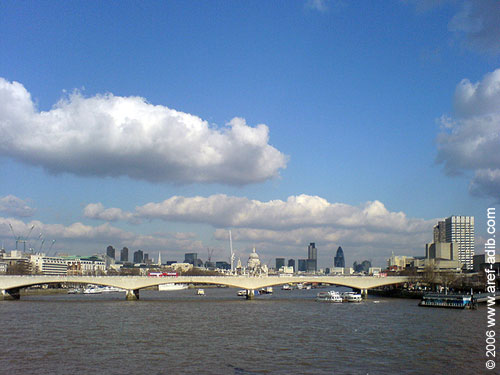
This is another picture I took on the London's South Bank with my mobile phone.
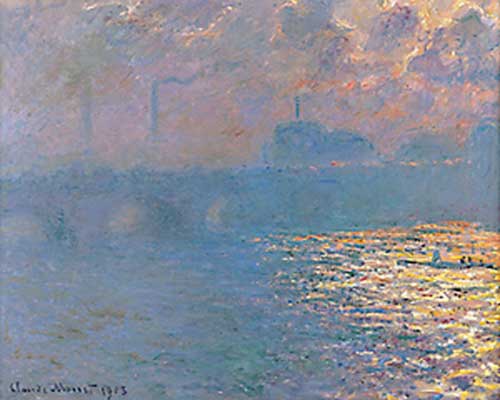
And here is the same bridge by Claude Monet:
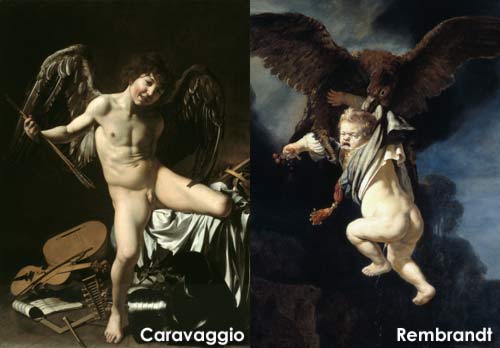
The 400th anniversary of the birth of Rembrandt is being marked at Amsterdam's Van Gogh Museum. For the first time an exhibition is being devoted to two of the greatest painters: Rembrandt van Rijn (1606-1669) and Michelangelo Merisi da Caravaggio (1571-1610). While the two artists never met, similarities are evident in their paintings such as their theatrical use of light and shade. Rembrandt studied Caravaggio's style with teacher Pieter Lastman, and all three painted The Sacrifice of Abraham. Caravaggio died four years after Rembrandt was born, but his works shows he learned much from his predecessor. The Rembrandt-Caravaggio exhibition runs from today to 18 June 2006.
>> Click here to compare the paintings!
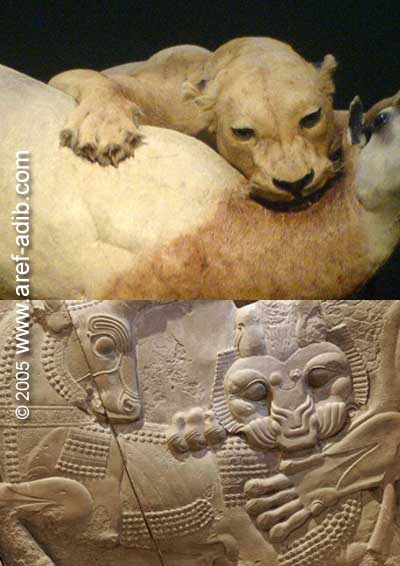
Diorama of a lion attacking an antelope and a stone relief on the western fa?ade of the west staircase of the Palace of Darius at Persepolis.
Last week I went to Henri Rousseau's exhibition at Tate Modern. Rousseau created some memorable and great paintings. One of them is his painting The Hungry Lion 1905, which was based on the diorama of a lion attacking an antelope. This also reminds me of the stone reliefs at Persepolis.
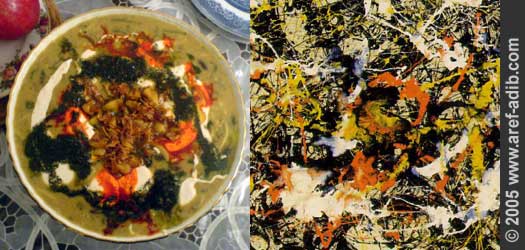
Ashe kashke Pollock-e, bokhori pAteh nakhori pAteh!
My mum's Ashe Reshteh (persian noodle soup) and a Jackson Pollock's painting!
>> View larger image
If you like Abstract Expressionism, you might also like Koobism (Persian Cubism):
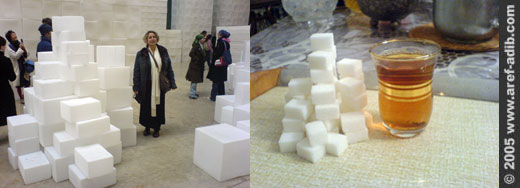
The picture on the right is of Rachel Whiteread's Embankment, the latest art installation to occupy Tate Modern's Turbine Hall.
Whiteread has created a labyrinth-like structure, made from 14,000 casts of the inside of different boxes, stacked to occupy Turbine Hall's huge space. Since the gallery opened in 2000, six artists have risen to the challenge of filling the 155 m x 35 m (500 ft x 115 ft) space.
>> More on Rachel Whiteread
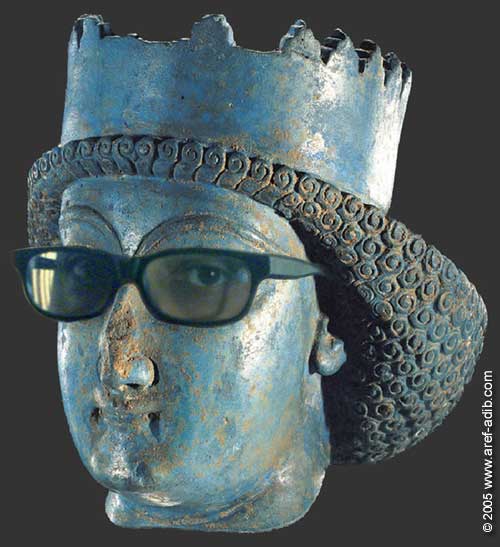
Lapis lazuli head of a modern Persian!
The Guardian and the British Museum hosted a public forum on what ancient Persia tells us about modern Iran on Tuesday October 18 2005.
>> You can listen to the full debate here.
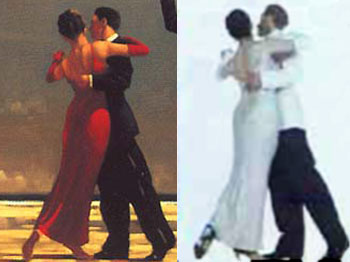
Works by Jack Vettriano, Scotland's most famous artist have fetched record prices at auction. But his paintings may owe a lot to teach-yourself manuals. Some of his works show strong similarities to an artist's teaching manual, it was reported yesterday. His most famous work, the Singing Butler, was last year sold for almost ?750,000. It was revealed that its characters, and many others, can be found in The Illustrator's Figure Reference Manual, published in 1987.
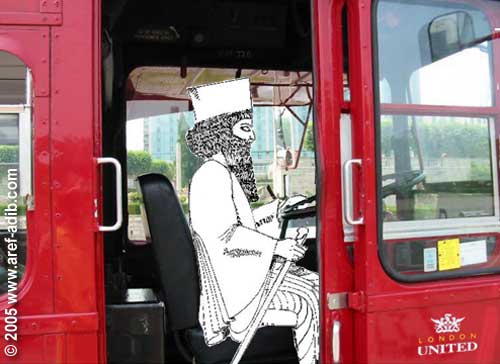
Darius the London Bus driver.
The British Museum's Forgotten Empire: The World of Ancient Persia stunning new exhibition reveals the power, magnificence and sophistication of the ancient Iran.
>> The Guardian Review
>> The Observer Review
>> The Times Review
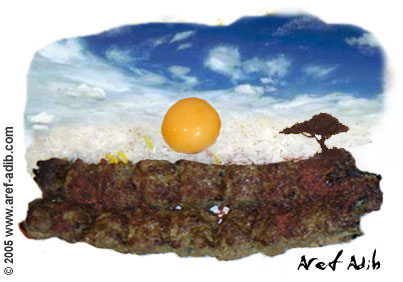
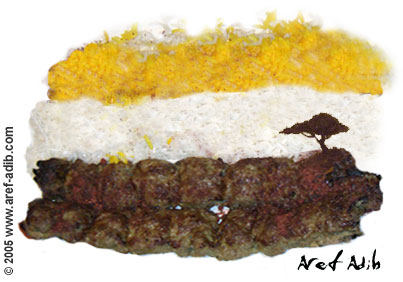
My favourite art form: Koobism!
Kebab Koobideh
4 Servings
500 grams ground lamb
2 large onions (grated)
1 large egg (beaten)
4 medium tomatoes
1/2 teaspoon salt
1/4 teaspoon black pepper
1 tablespoon sumac (optional)
Mix meat, onions, egg, salt and pepper well and leave in the refrigerator overnight.
Press the meat around long, thick metal skewers and shape evenly. Thread whole tomatoes on another skewer. Barbeque each side for about five minutes, turning frequently. If skewers are not available or barbequing is not possible, kabab-e koobideh can be shaped into long, thin portions on aluminum foil and grilled at high temperature in the oven. The oven should be pre-heated and kabab-e koobideh should be placed as high as possible near the source of the heat. Serve with hot pilau or bread. If serving with rice, some sumac may be sprinkled on top.
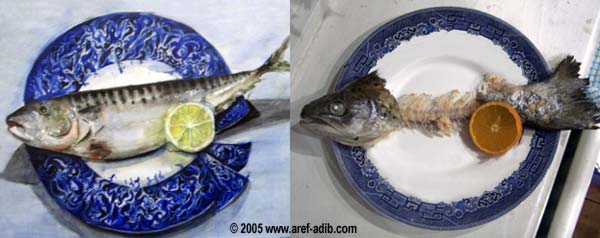
The painting on the left is a watercolour I painted twenty years ago. The photo on the right was taken by Yousef (Joe) Aref-Adib last night!
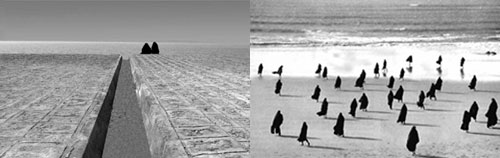
The picture on the left is taken recently in Bushehr (where Iran's Nuclear Power Station is located) and the one on the right is by artist Shirin Neshat.
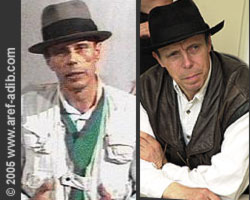
Joseph Beuys & Gunther von Hagens
Joseph Beuys (1921-86) is considered one of the most influential figures in modern and contemporary art. Joseph Beuys: Actions, Vitrines, Environments is at Tate Modern from today until 2 May. Gunther von Hagens dissects the bodies and wears a hat and vest that recalls Beuys.
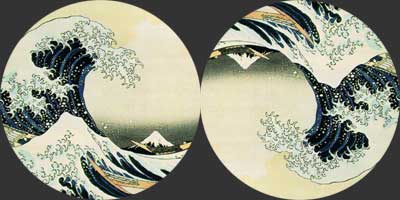
Hokusai's most famous picture is a large wave that forms a yin to the yang of empty space?nature's yin and yang of life and death. According to Chinese philosophy all opposites that one experiences?health and sickness, wealth and poverty, power and submission?can be explained in reference to the temporary dominance of one principle over the other. All phenomena have within them the seeds of their opposite state and even though an opposite may not be seen to be present, no phenomenon is completely devoid of its opposite state. This is called presence in absence or as I see it we are all in a queue for the next big wave.
Worldchanging has just published a roundup of first-person accounts and news related to the tsunami disaster.
Wikipedia on the Indian Ocean earthquake.
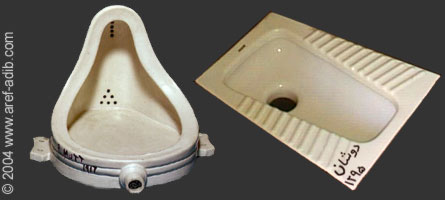
Marcel Duchamp's 1917 Fountain and the Iranian version.
Marcel Duchamp's Fountain, a 1917 porcerlain urinal, has been voted the most influential artwork of the 20th century, in a poll of Britain's art world. According to a British art expert the work reflects the dynamic nature of art today!
2. Picasso, Les Demoiselles d'Avignon
3. Andy Warhol, Marilyn Diptych
4. Picasso, Guernica
5. Matisse, The Red Studio
6. Joseph Beuys, I Like America and America Likes Me
7. Constantin Brancusi, Endless Column
8. Jackson Pollock, One: No 31
9. Donald Judd, 100 untitled works in mill aluminium
10. Henry Moore, Reclining Figure 1929
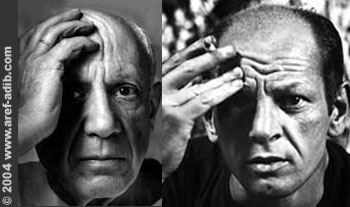
Pablo Picasso and Jackson Pollock
Pollock's major influence was Picasso. As you can see he was also influenced by Picasso's look!
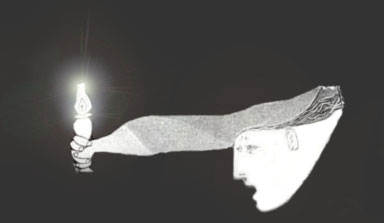
Picasso's Guernica still retains its power to offend and shock. According to Gijs van Hensbergen's new book Guernica: The Biography of a Twentieth-Century Icon, the United Nations in New York has a copy of it in tapestry. It hangs in a corridor outside the Security Council's meeting room, where it acts as a visible reminder of cruelty of war. Last year, however when Colin Powell attempted to persuade the UN into legitimising the war in Iraq the tapestry was suddenly covered!
This censorship recognises the great power of Art. ?What the picture showed up,? says Van Hensbergen, ?was the embarrassing contradiction of presuming to take the moral high ground while simultaneously campaigning for war?.
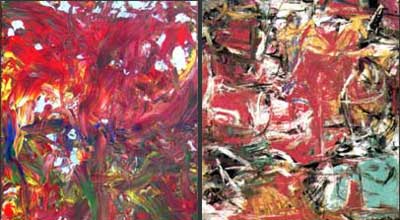
Can you spot which painting is by a turtle and which is by Willem de Kooning?
Answer: The painting on the left is by a turtle and the one on the right is by Willem de Kooning.
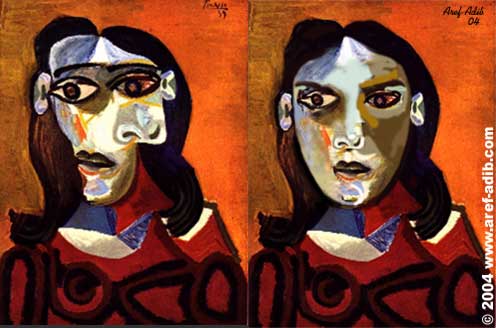
For the past six months, Picasso?s ?Les Demoiselles d?Avignon? has been undergoing a major restoration in the Museum of Modern Art in New York. Read about it here.
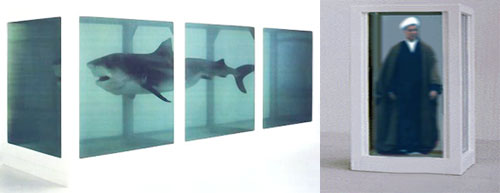
Shark & Kouseh
(Kouseh is Rafsanjani?s nickname. It is playing on the word kouseh which means both shark and beardless in Persian).
The Britart exhibition ?Turning Points: 20th Century British Sculpture? has opened during the twenty-fifth anniversary of the Islamic Revolution, and just four days after national parliamentary elections. The exhibition is presenting a new generation of Iranians with original works of British art. Apparently the entire space of the Tehran Museum of Contemporary Art has given over to this exhibition.
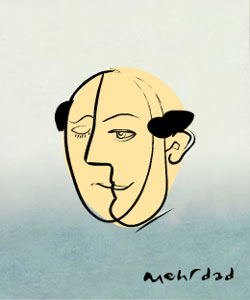
Mr Picasso Head website lets you paint your own Picassoesque portrait by offering a number of his motifs. It is a bit limited but still great fun!
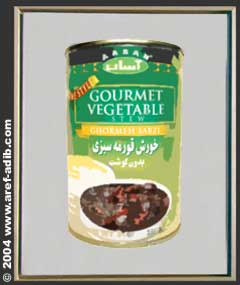
After Campbell's Soup by Andy Warhol.
Last Friday night there was a feast of Iranian Contemporary Art and Food in V&A. The smell of Ghormeh Sabzi had filled the museum. Sadly it was so crowded that I missed the food, the dance and the fashion part of the programme. I managed to attend Abbas Kiarostami and Seifollah Samadian?s conversation with Geoff Andrew and watch two short films by Kiarostami -- Moonlight and the Lagoon. At the moment his choice of medium is digital video. Kiarostami himself shot the films in northern Iran, near the Caspian Sea. Apparently in Moonlight he tries to capture the relationship between frogs and the moon on a rainy night!
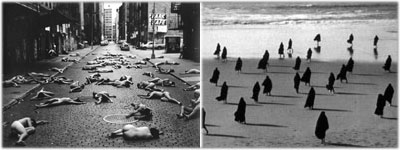
I can see a lot of similarities between these two images. Both artists live and work in New York. The image on the right is by the Iranian artist Shirin Neshat and the one on the left is by the American artist Spencer Tunick.
Spencer Tunick started "Nude Adrift", a world project, in 2001. His goal is to complete a body of work while travelling to all the continents. The project combined the artist's mass group installations, as well as a series of individual portraits. He has been documenting the live nude figure in public using photography and video since 1992 and has organised over 65 group installations. Last Sunday He beat his own record when 7,000 people posed nude for him in Barcelona.
Today we went to British Museum and saw the exhibition " The Museum of the Mind: Art and memory in world cultures". The idea and concept was fine but the exhibition itself was just a mishmash of artefacts. The opening speech to the exhibition by Ben Okri is quite interesting.
We also had the chance to hold a genuine cuneiform clay tablet from ancient Mesopotamia, which was great! The cuneiform was used most extensively in the ancient Middle East. It was employed for writing a number of languages from about the end of the 4th millennium BC until about the 1st century BC. The earliest documents in cuneiform were written in Sumerian, the language of the inhabitants of southern Mesopotamia. Cuneiform writing was impressed onto clay tablets with a reed stylus.
Today I went to two very different exhibitions:
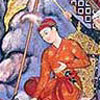
V&A’s “THE ADVENTURES OF HAMZA” from Hamzeh-nameh.
Absolutely fantastic!
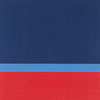
Serpentine Gallery's exhibition of German artist "Blinky Palermo".
Well it was interesting but not outstanding!
THE LEARNER
First I built on sand, then I built on rock.
When the rock caved in
I no longer built on anything.
Then I often built again
On sand and rock, as it came, but
I had learned.
Those to whom I had entrusted the letter
Threw it away. But those I paid no attention to
Brought it back to me.
Thereby I learned.
What I ordered was not carried out.
When I arrived I saw
It was wrong. The right thing
Had been done.
From that I learned.
The scars are painful
Now it is cold.
But I often said: only the grave
Will have nothing more to teach me.
Bertolt Brecht